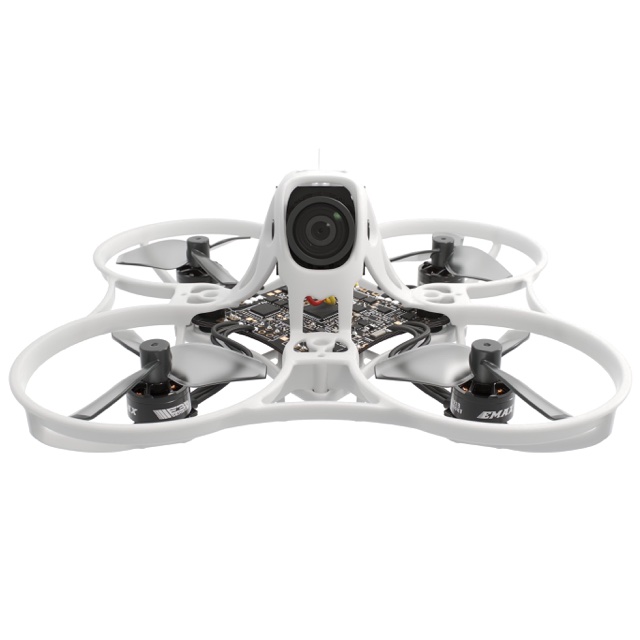
EMAX Tinyhawk Aero HDZero
EMAX
65mm fully 1S race whoop; three factory motor options, or analog
EMAX's first purpose-built racing whoop: a 65mm fully ducted 1S platform with 2.4GHz and genuine HDZero digital video. Three factory motor options cover smooth control, race-day response, or maximum thrust on the same airframe.
Sold as a preorder. EMAX lists an estimated ship date around October 16, 2026 for all HDZero motor options.
Uses EMAX's EM2.0 battery connector, so 1S packs with BT2.0, A30 or PH2.0 plugs do not fit without changing the connector.
HDZero versions need HDZero-compatible goggles or a receiver; no radio, goggles or battery is included.
The full story
The HDZero and analog editions are different electronics packages, not a swap. The HDZero build runs an STM32F411 5-in-1 with a 4-in-1 5A , an integrated 5V 1A , an HDZero VTX at 25/200mW, and the HDZero ECO (HDZ3261) camera — a 1.8g 1/3-inch sensor doing 720p60 at 4:3 with a 150-degree diagonal . The analog build instead uses an STM32G473 5-in-1 AIO, a 6A ESC, a 40-channel 25/100/200/400mW VTX and an E03 camera.
Three motor options ship on one 65mm airframe, each paired with its own HQProp 31mm tri-blade: 0702B 27,000KV on a 1.2×1.1×3 prop (142g combined max thrust), 0702B 30,000KV Racing on 1.2×0.9×3 (147.6g), and 0702 35,000KV Performance on 1.2×0.9×3 (174g). The power character is chosen at purchase rather than tuned later.
HDZero costs weight and flight time against the analog build. Dry weights run 18.9g Freestyle, 18.8g Racing and 19.3g Performance versus 16.4g / 16.3g / 16.9g analog. EMAX's own controlled hover benchmarks drop correspondingly: Racing goes from about 5:07 analog to about 3:10 HDZero, and Performance from about 4:48 to about 2:54. Maximum dimensions are 85 × 85 × 40mm and the complete frame assembly — tray, mount and hardware — is 3.7g.
Power reaches the ESC through EMAX's EM2.0 connector, published at 10A continuous, 20A burst and 12.5mΩ internal resistance against BT2.0's published 9A and 15A. EMAX publishes the EM2.0 design package, STEP model and battery test document on GitHub. The aircraft was performance-tested around that connector, so converting a pack to another plug changes the tested electrical path.
It is bind-and-fly only: no radio, goggles or battery in the box. Every version carries an ExpressLRS 2.4GHz receiver, and the HDZero versions need HDZero-compatible goggles or a receiver. The airframe is also selectable in Liftoff: Micro Drones from version 1.1.2.
Pros & cons
Pros
- Genuine HDZero digital video — HDZero ECO camera and a 25/200mW HDZero VTX — in a 65mm 1S ducted airframe that still comes in under 19g dry.
- Three factory motor options on one airframe (27,000KV Freestyle, 30,000KV Racing, 35,000KV Performance), each with its own matched HQProp 31mm tri-blade, so the power character is a purchase decision rather than a rebuild.
- Full-coverage ducts around all four propellers, with the FPV lens set inside a tall structural canopy — the protection a race whoop needs for side impacts.
Show all 6 pros
- ExpressLRS 2.4GHz is fitted to every version, analog and HDZero alike, so no receiver choice or adapter is involved.
- The EM2.0 battery connector is published at 10A continuous, 20A burst and 12.5mΩ internal resistance, against BT2.0's published 9A and 15A — more current headroom at full throttle.
- Selectable in Liftoff: Micro Drones from version 1.1.2, so stick time on the exact airframe is available before the aircraft ships.
Cons
- HDZero roughly cuts the hover benchmark against the analog build: EMAX's controlled figures fall from about 5:07 to about 3:10 on Racing, and from about 4:48 to about 2:54 on Performance.
- The HDZero electronics add about 2.5g over analog (18.8g versus 16.3g dry on the Racing build), which a 65mm 1S airframe feels.
- EM2.0 is an EMAX-specific connector, so an existing 1S fleet on BT2.0, A30 or PH2.0 does not plug in — and changing the plug departs from the power path EMAX tested.
Show all 6 cons
- The HDZero VTX tops out at 200mW where the analog edition offers 400mW, leaving less link headroom.
- EMAX does not publish whether the onboard receiver is or serial, so its firmware-update path and transmitter version coupling are unknown before purchase.
- The camera is the HDZero ECO, the entry-level HDZero sensor at 720p60 in 4:3 — not a Nano V3 or Lux.
Specs
Retailers & price history
| Retailer | Current | Stock | Lowest confirmed | Highest confirmed | Checked |
|---|---|---|---|---|---|
| EMAX USA Preorder listing; the HDZero motor options are sold as variants of the analog product page. |
$249.99 | In stock | $249.99 (2026-09-21) | $251.99 (2026-09-21) | 2026-10-05 |
Current = cheapest ready-to-fly configuration (video system included, ELRS) tracked at that retailer; sold-out rows show the last listed price. Lowest/highest are from every confirmed scan since 2026-07-02 — the log grows with each stock check.
Replacement parts & batteries
Crash spares that fit this model, checked against the shops like everything else. Batteries show three price tiers — $ lowest, $$ middle, $$$ highest — among compatible in-stock packs.
Batteries
| Part | Price | Availability |
|---|---|---|
| EMAX 1S 300mAh HV LiPo — EM2.0 $ 1S 300mAh HV LiPo · EM2.0 · charges to 4.35V |
$4.89 | In stock at EMAX USA |
| EMAX 1S 270mAh HV LiPo — EM2.0 $$$ 1S 270mAh HV LiPo · EM2.0 · charges to 4.35V |
$4.89 | In stock at EMAX USA |